



Beyond Pure-Play Defense: The Investment Case for Dual-Use Technology

Private capital is moving into defense technology faster than federal contracts are following it. The 100 venture- and private equity-backed companies on the Silicon Valley Defense Group (SVDG) 2026 NatSec100 received $4.3 billion in federal obligations in fiscal 2025, up 22% from a year earlier. Excluding OpenAI, they raised $39.6 billion in private capital in 2025, and their total private funding exceeds their lifetime federal awards by $102.2 billion.

That gap sits at the center of the investment case for dual-use technology. A platform that sells one core product to commercial and government customers can fund the climb to production with revenue that doesn't depend on a federal budget cycle. The label only carries weight when the commercial business is real, though, and when the platform's IP, ownership and supply chain can clear the federal bar for prime contracts. For capital allocators, those two tests separate a dual-use platform from a defense company with a commercial slide in its pitch deck.
What dual-use technology means in practice
Federal law takes a broad view of dual-use technology. Under 10 U.S.C. § 4801, the term covers products, services, standards, processes and acquisition practices capable of meeting both military and nonmilitary requirements.
Commercial-first companies add government customers to a product that already sells in the private market. Databricks, an enterprise data platform, ranks sixth on the 2026 NatSec100. Government-first companies move the other way. Palantir, long defined by its federal work, reported second-quarter 2026 U.S. commercial revenue of $764 million, up 149% year over year, against $809 million from the U.S. government.
Either way, the label needs evidence. A credible dual-use company sells the same core technology into both markets. Its commercial customers pay commercial prices, and no single government program dictates its roadmap. The current market tilts toward defense-first models, though. SVDG executive director Mike Keating noted far fewer commercial-first companies on the 2026 list, with most leaders defense- or government-first.
Why domestic IP matters
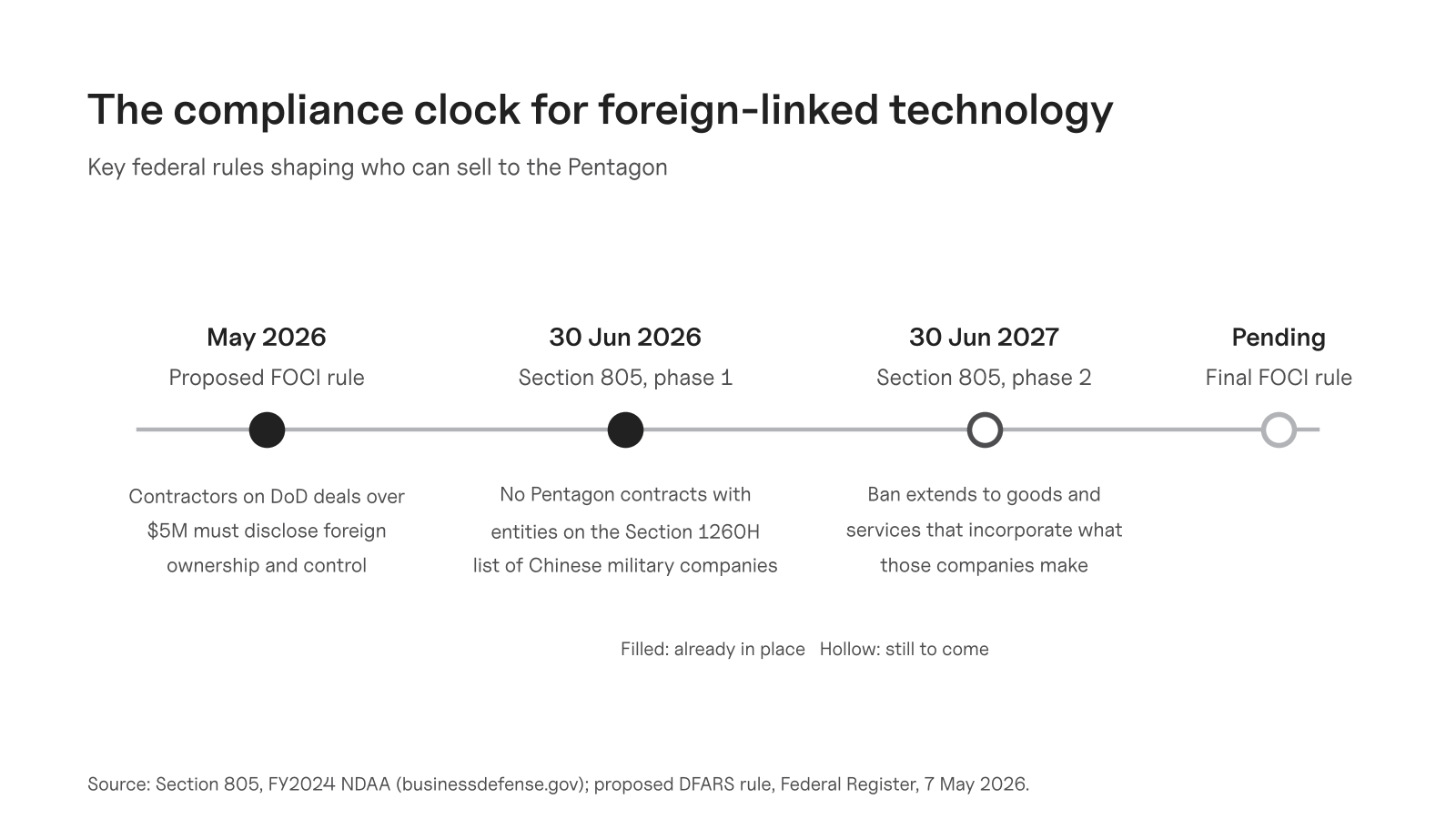
Federal buyers now look hard at where technology comes from and who controls it. Since June 30, 2026, Section 805 of the FY2024 NDAA has barred the Pentagon from contracting with entities on its Section 1260H list of Chinese military companies. On June 30, 2027, the ban extends to goods and services that incorporate what those companies produce or develop.
A proposed DFARS rule from May 2026 would also require contractors and subcontractors on DoD contracts above $5 million to disclose beneficial ownership and any foreign ownership, control or influence (FOCI). Flagged companies would have 90 days after award to mitigate the risk. Commercial items would be exempt unless a senior DoD official finds a national security risk.
Allied-origin technology faces a different test. U.S. law counts Canada, the U.K., Australia and New Zealand in the national technology and industrial base, yet contract eligibility still turns on control and supply chain. Domestication usually means a U.S. entity that owns or exclusively licenses the core IP, U.S. citizens in key management and security roles, and onshore production. For cleared work, DCSA scales its mitigation tools to the degree of foreign control, from exclusion resolutions up to special security agreements, voting trusts and proxy agreements.
The model can move quickly. Orqa U.S., formed in May 2026 by Croatian drone maker Orqa and defense contractor By Light, is U.S.-owned and has a board made up solely of U.S. citizens. It builds in Florida and is the sole authorized provider of Orqa's technology to U.S. government customers. In October 2026 it announced a $38 million order under the Pentagon's Drone Dominance Program. For investors, ownership and IP structure set how much of the federal market a platform can reach.
Where private equity capital is active
Venture capital bets cluster in applied AI, quantum and battlefield information, and contested logistics, according to SVDG's analysis. Private equity concentrates on the industrial layer underneath. PE investors made an estimated 143 deals in aerospace and defense in the first quarter of 2026, worth $11.3 billion, more than double the deal count of a year earlier (PitchBook).
PitchBook singles out defense electronics as a focus, alongside fast-growing niches such as drones, the missile and missile defense supply chain, and shipbuilding.
Sponsors are spreading capital across more, smaller deals. In the second quarter, defense deal count rose to 44 from nine a year earlier, while total aerospace and defense deal value fell almost 58%, as investors favored smaller growth-equity checks and bolt-ons over large platform buyouts (PitchBook).
The investment thesis
Diversified revenue comes first because federal money arrives on Washington's schedule. The Pentagon began fiscal 2027 under a continuing resolution that holds spending at 2026 levels through Dec. 11. Citing GAO, Air & Space Forces Magazine notes it's the 38th time in 50 years the department has started a year that way. Continuing resolutions generally block new program starts. Commercial revenue keeps teams and production lines working through the delay.
Mission relevance sets the ceiling on the government book. The White House requested $1.5 trillion for defense in fiscal 2027, with priorities that include Golden Dome missile defense, munitions, the industrial base and acquisition approaches meant to bring in new entrants. Congress appears unlikely to approve the full amount, but platforms aligned with those priorities have the clearest path to larger awards.
Defensibility comes from what competitors can't copy quickly. Personnel clearances alone can take six months to a year, and enterprise agreements raise switching costs once a platform becomes a program's default. In March 2026 the Army folded more than 120 procurement actions for Anduril's commercially available products into one 10-year contract with a ceiling of up to $20 billion (Defence Matters).
The risks
Export controls create the central tension in dual-use investing. Commercial technology generally falls under the Commerce Department's Export Administration Regulations, but once a product is "specially designed" for defense applications it can move under the State Department's ITAR, which takes precedence. That shift can shrink the international sales a commercial business is supposed to deliver.
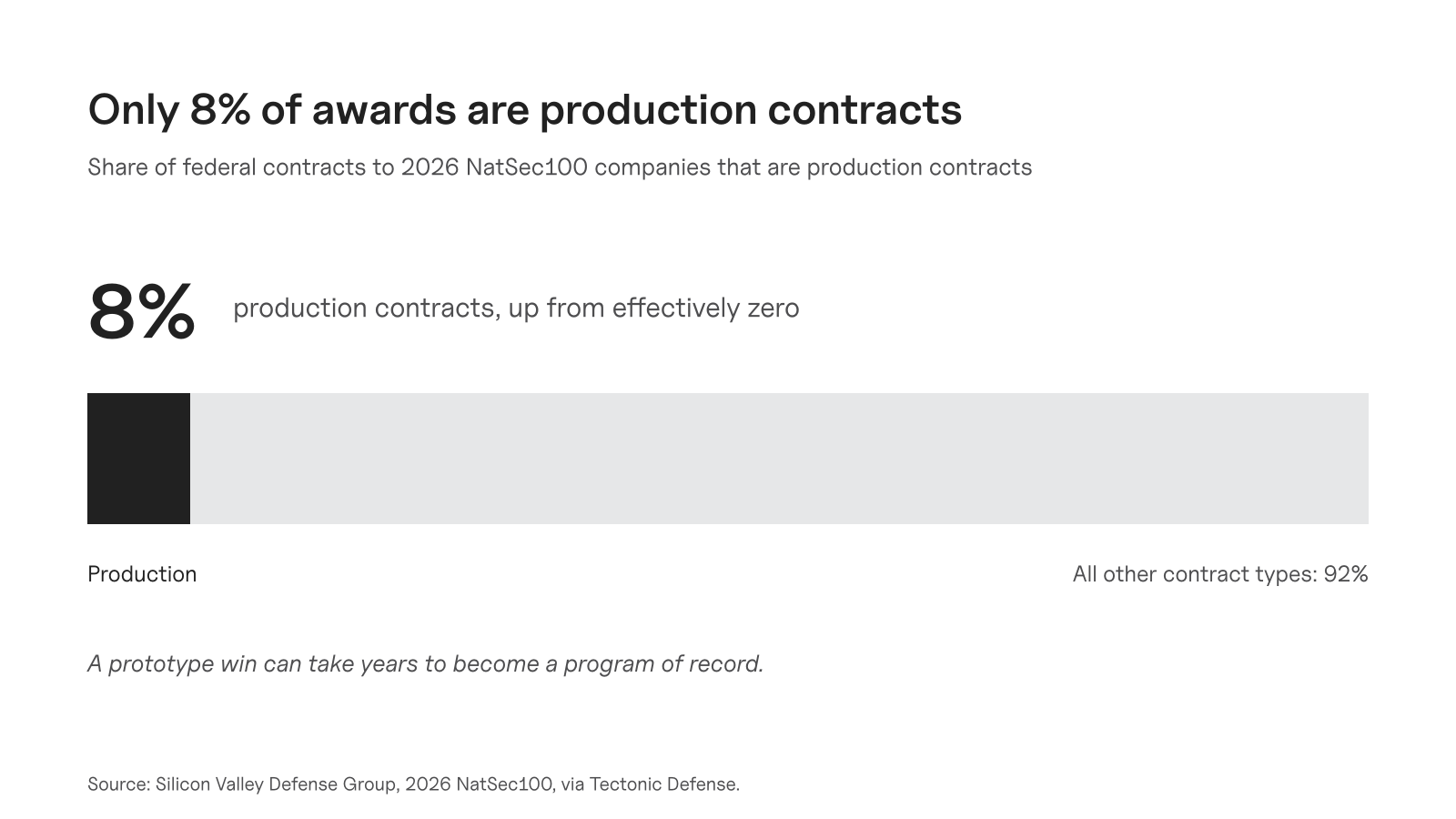
Sales cycles remain long. Only 8% of awards to NatSec100 companies are production contracts, up from effectively zero (SVDG). A prototype win can take years to become a program of record.
Outlook
Policy is moving in dual-use technology's favor, though budgets lag. The second phase of Section 805 takes effect June 30, 2027, the FOCI disclosure rule awaits a final version, and contracting offices are opening more solicitations to nontraditional vendors (SVDG). Funding is less settled, and one budget analyst suggests the fiscal 2027 base budget may not clear Congress until spring 2027.
Over the next three to five years, allocators should track the share of awards that convert to production and how fast foreign-origin platforms complete domestication. Platforms that pair real commercial revenue with domestic IP and production capacity stand to gain the most.
Related reading: Why Ecosystem Thinking Will Define the Next Era of American Competitiveness and Robots, Capital, and Geopolitics: The Contest of the Next Decade.
