


Why Skill Is Not a Strategy: Lessons From the Gambler’s Ruin

Skill alone can’t overcome a large resource gap. The gambler’s ruin, a probability puzzle first posed in 1656, shows why: even with a real edge, a smaller player risks ruin when each bet is too large for its bankroll. Size decisions so a bad streak is survivable, and the advantage gets time to work.
A better product does not automatically beat a larger rival. That sounds like cynicism. It is closer to a homework problem. In the 1650s, mathematicians asked what happens when two people play until one of them is broke. The answer is still sitting in probability textbooks, and it is harder on talented underdogs than most strategy decks admit.
Dice, counters, and a game that has to end
In 1656, two years after their letters on how to split the pot in an unfinished game, Blaise Pascal sent Pierre de Fermat a different question. What if the players keep going until one of them has nothing left? Christiaan Huygens published a version the next year in De ratiociniis in ludo aleae — “On Reasoning in Games of Chance” — the first printed book on mathematical probability.
The rules are almost insultingly simple. Two players start with finite piles of money. They play the same bet over and over. After each round, one pile shrinks and the other grows by the same amount. The match ends when one pile hits zero.
William Feller later wrote this up as a random walk with walls at both ends: ruin on one side, taking the whole pot on the other. The walk hits a wall with probability one. Someone goes broke. The interesting part is not the ending. It is how the starting piles and the per-round odds decide who walks into the wall.
Give the smaller player an edge and watch it fail
Call the smaller player David and the larger one Goliath, if that helps.
David starts with $2,000 and wins each round 55% of the time. Goliath starts with $10,000 and wins the other 45%. They play until one of them is cleaned out.
If each round is a $1,000 transfer, David has two units and Goliath has ten. Goliath needs two net wins. David needs ten. That is not a close fight dressed up as a skill contest. It is a long hallway with a cliff two steps behind one of the runners.
When the per-round chances are not 50/50, David’s probability of taking the whole pot follows a formula that has sat in textbooks for decades:
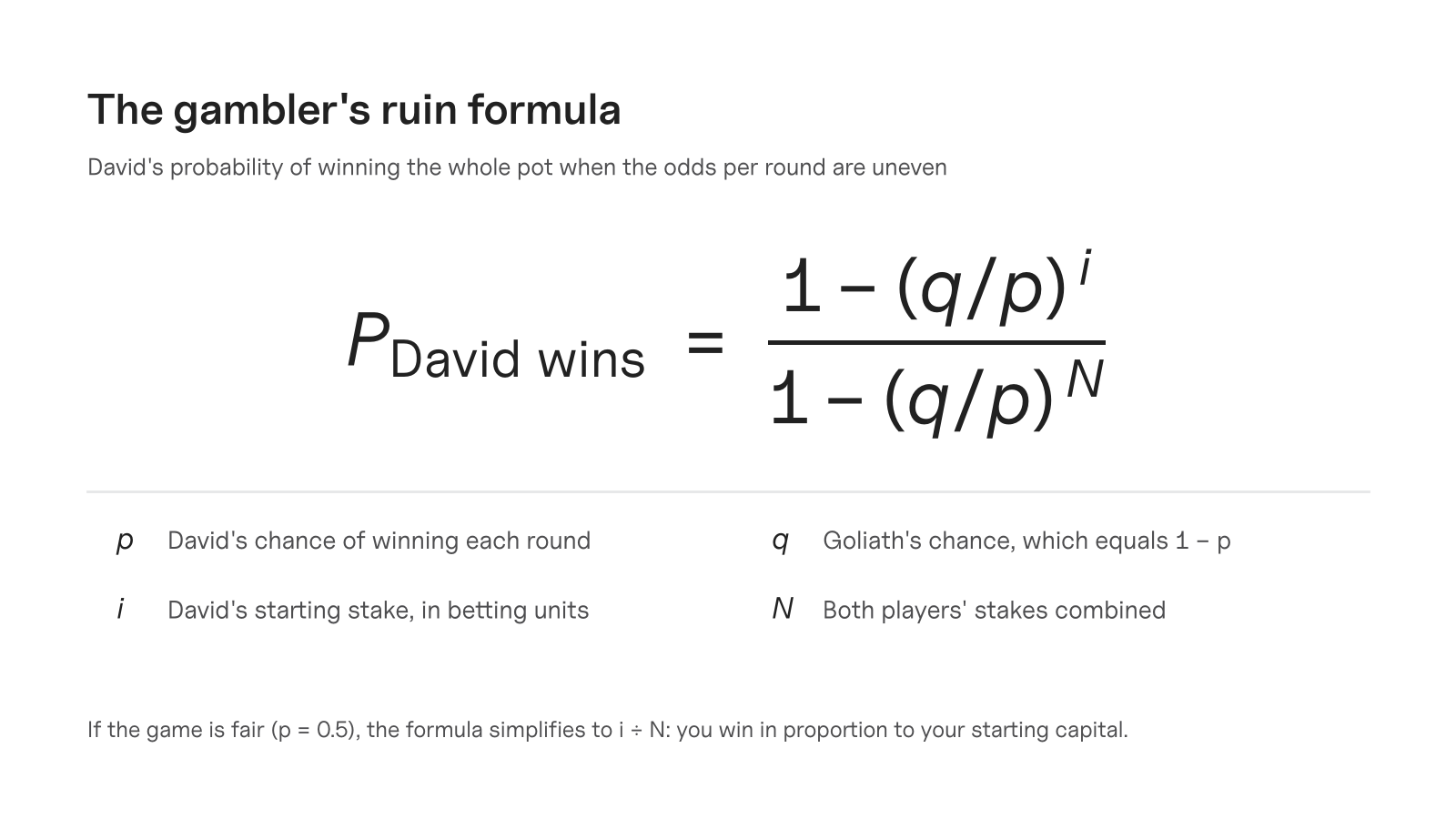
If the game is fair, the formula collapses to a simpler and bleaker fact: you win in proportion to your starting capital. Two dollars in a twelve-dollar pot wins 2/12 of the time. Feller has this; so do the lecture notes that still teach it.
Plug in a 55% edge, two units, and twelve units on the table, and David wins about 36% of the time. People expect a favorite. The arithmetic produces an underdog. Ten extra points (of edge) per round isn’t trivial, but it’s also not enough when a smaller bankroll is two unlucky steps from zero. This is why undercapitalized ventures so often fail, even when the offering is compelling.
Against a casino (or moated incumbent) — an opponent who cannot go broke — the formula simplifies further, and David’s chance of surviving forever depends only on his edge and his starting units. Two units and a 55% edge: about 33%. Twenty units: about 98%. The edge barely moved. The distance to the cliff did.
So the first lesson is not “skill doesn’t matter.” It is narrower and worse. A modest quality advantage does not cancel a large resource gap if the fight is a string of large, all-or-nothing transfers. “We are better than the incumbent” is just a way of saying p = 0.55. It does not answer the only question the formula cares about: how many losses can you absorb before you stop playing?
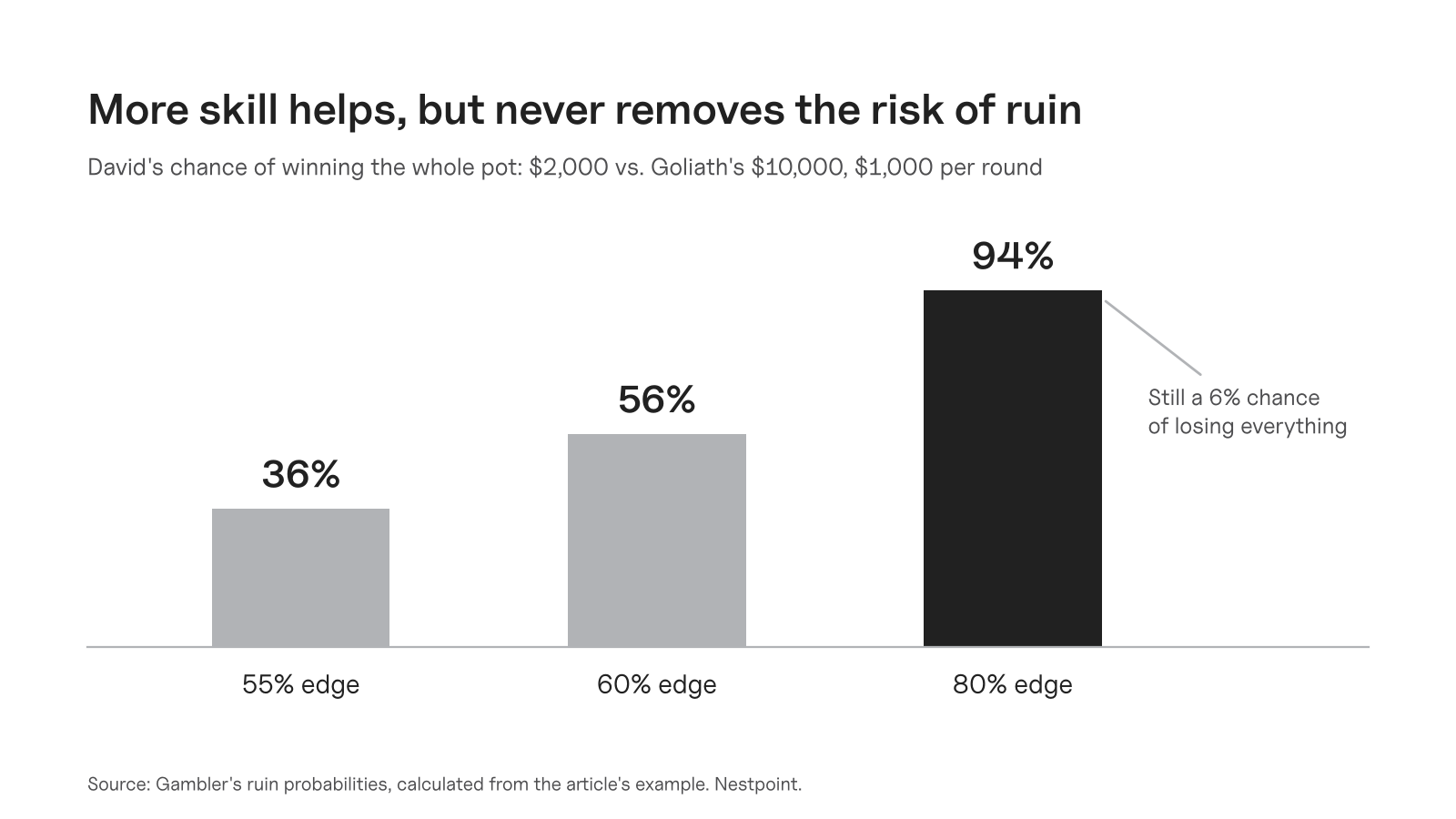
Raise the edge and the picture improves, then stalls. At two units against ten, a 60% per-round edge makes David a slight favorite, around 56%. An 80% edge gets him to about 94%. Even that last number is not the comfort it looks like, because the remaining 6% still ends the firm.
Same players, smaller chips, different sport
Leave everything else alone. Same $2,000 and $10,000. Same 55/45. Cut the stake per round from $1,000 to $100.
David now has twenty units. Goliath has a hundred. The pot is 120. Run the same formula, and David wins about 98% of the time.
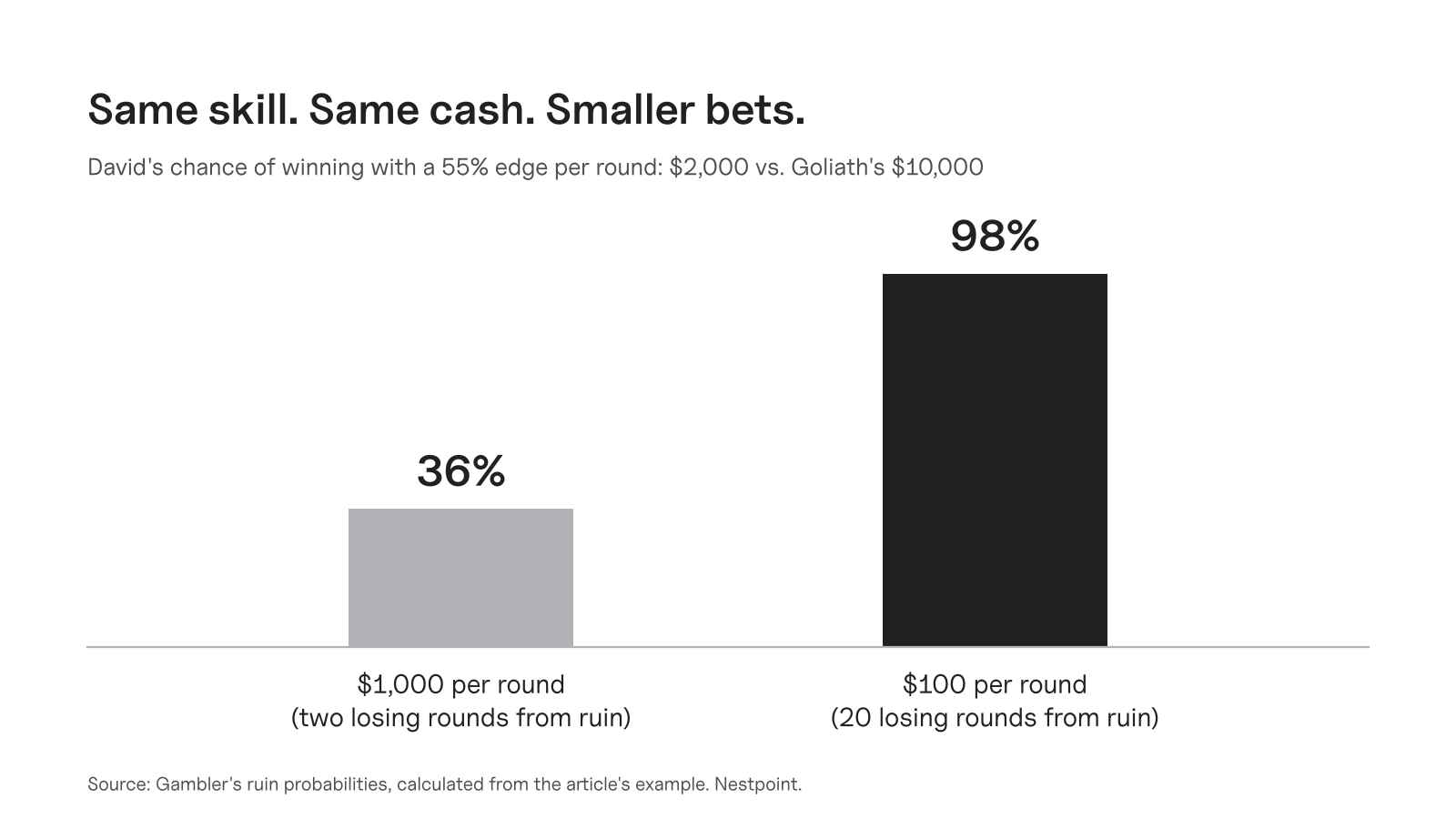
Nobody got smarter. The cliff moved. Two losses used to be fatal. Twenty losses in a row, each at 45%, is a different kind of bad luck — the kind that almost never shows up. The edge finally has room to do what people assumed it would do in the first version.
This is the part worth stealing. Small players often die with an edge intact because each decision is too large relative to the cash they can lose. Shrink the decision and the same edge starts to look like destiny.
People who size bets for a living already have a name for the middle ground between “bet nothing” and “bet the company.” In 1956 John Kelly, working from Claude Shannon’s information theory, asked what fraction of a bankroll you should wager when you actually have an advantage. Bet too small and the edge goes to waste. Bet too large and a normal losing streak wipes you out, advantage and all. Edward Thorp carried that rule from blackjack to Princeton-Newport Partners, one of the early quantitative hedge funds. The version practitioners actually use is usually half or a quarter of Kelly’s full number, because the formula assumes you know your edge. You don’t. Overestimate it, bet full Kelly, and you can have a real advantage and still shrink over time.
Thorp’s other warning is the grim twin of gambler’s ruin. If you try to maximize dollars on every single trial — shove in the whole stack whenever the expected value is positive — you go broke with probability heading toward one, as long as you can lose a given trial at all. The usable region is duller than that: small enough that a bad month is not the end, large enough that the edge still compounds.
Big companies live in that region without reciting the theorem. Amazon’s Fire Phone was a genuine flop. In the third quarter of 2014 the company wrote down $170 million for unsold phones and supplier commitments, with $83 million of inventory still sitting there. The quarter lost $437 million. That is a bruise, not a funeral. Amazon was already selling tens of billions a year; a dead phone sat next to retail, AWS, and later devices that worked.
Google has spent twenty years launching things and then switching them off. The public graveyard at Killed by Google is up around 300 products since 2006. A normal year is closer to a dozen sunsets than a hundred. 2019 was an ugly exception. The point is not that Google is uniquely fickle. It is that a company with a fat cash engine can treat most attempts as disposable. A company whose entire existence is the attempt cannot.
So the useful question is not “do we believe in experimentation?” It is how much of the current pile this one decision puts on the table. If the down case is that there is no next decision, the bet is too big. The odds can still be good. That does not make the position size sane.
Some games grow the pot. Some only pass it around.
In the original puzzle, David’s dollar is Goliath’s dollar. The table does not mint new money. With a finite pile and endless transfers, someone has to empty out.
That is a poor picture of a lot of businesses, and a painfully good picture of some others.
A price war in a market that is not growing behaves like the table. Share taken is share denied. The thinner balance sheet hits zero first. Software, media, platforms, and a lot of services are sloppier than that. A new customer is often new demand, not a stolen unit. Sometimes more participants make the thing more valuable for the people already there.
A blunt test: when you win an account, did someone else have to lose one, or did the market just get larger? If it had to come out of a rival’s hide, capital and time-to-broke start to matter more than how clever the product feels.
Two footnotes, because this is the slide that turns into a bumper sticker.
Growing markets are still full of competition. SaaS companies steal from each other every week. Winner-take-most categories exist. The claim is only that the cliff is less steep when some of your growth can come from expansion instead of extraction.
And cash is still finite even when the industry is expanding. You can be in a generous market and still die in a stingy financing game — burn, runway, the next raise. Ruin just moves upstairs.
Make their extra money hard to use
Goliath’s spare $8,000 only counts if the current round can absorb it. At $100 a hand, most of a $10,000 stack is scenery. The interesting move, if you are small, is to pick a fight in which the other side’s best assets do not score.
Clayton Christensen spent a career on a related idea. Incumbents get very good at improving the thing their most profitable customers already buy. They ignore the cheap, small, or awkward corner because it looks like a rounding error. Someone else starts there, then climbs. By the time the corner is large enough to notice, the new architecture is good enough for the customers the incumbent actually cares about.
The usual examples are messy. They are still the right examples.
ARM did not outspend Intel building PC chips. It started as a low-power design out of Acorn, useful in places Intel’s high-margin x86 business was not designed to love. Intel even owned an ARM-based line, XScale, and sold it to Marvell in 2006. Paul Otellini later said Intel passed on making chips for the first iPhone; the price and the expected volume did not clear the margin bar. Mobile became the volume computer. ARM-based designs took the volume. Intel was not imaginary. It was aimed at a different game, and the economics that made that game wonderful made the new one look like a bad use of a factory.
In 2000 Netflix talked to Blockbuster about a sale in the neighborhood of $50 million. Blockbuster had the stores and, around then, something like $800 million a year in late fees. It passed. Netflix did not try to win at strip-mall real estate. It built mail-order, then streaming, in a world where stores were first irrelevant and then a problem: leases, headcount, and a habit of charging people for being late. Blockbuster filed for bankruptcy in 2010. The fable is now worn smooth, and Netflix itself nearly died in the DVD years. The structure is still the point. The incumbent’s strongest assets defined a game the other company declined to play.
Airbnb did not need a hotel chain to put rooms on the market. It pointed demand at spare space hotels did not own. The academic work is less cinematic than the keynote version. Airbnb supply does chip away at hotel revenue, rates, and occupancy in big markets, but not evenly. Midscale properties tend to feel it more than luxury. Weekends and leisure overlap more than Tuesday-night corporate travel. Hotels were not abolished. A slice of demand moved onto a supply curve the chains did not control.
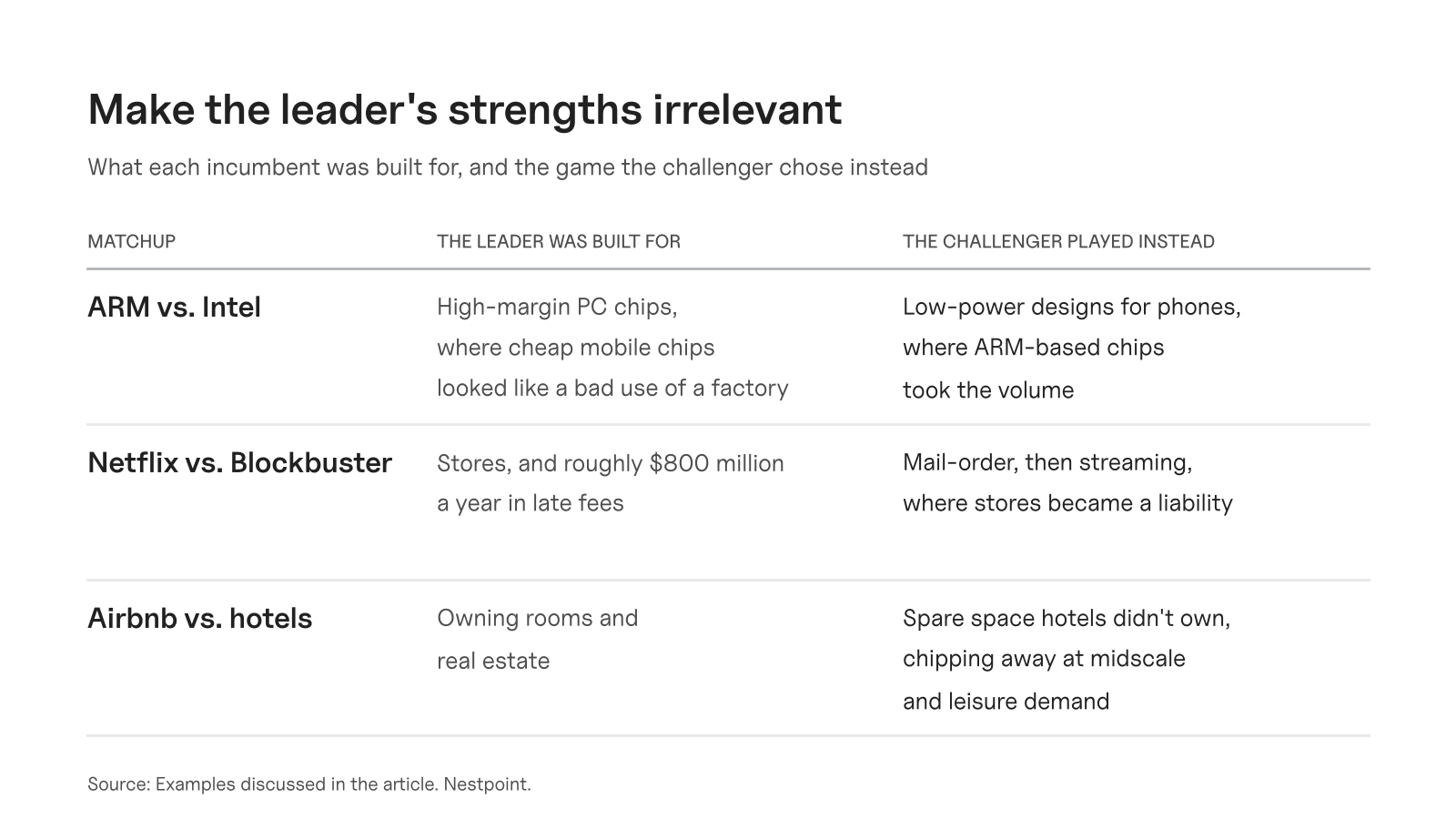
If you want a working version of this, write down the three things that make the category leader hard to fight. Then ask what kind of contest would make those three things expensive, idle, or actively in the way. That is often the market worth entering. It is also the market the leader cannot enter without picking a fight with its own P&L.
Ninety-four percent is not a plan if the other six percent is death
Put David’s per-round chance at 80%, keep the $1,000 chips, keep two units against ten. He wins about 94% of the time.
Six percent sounds small until six percent is the case where you do not get another try.
This is why people who last in markets, trading pits, and actual casinos refuse to put the whole stack on a single thesis, even a beautiful one. You will be wrong. The question is whether being wrong is an anecdote or an ending. Bet as if every win should be maximized and, so long as a given bet can lose, ruin becomes the long-run destination.
If the honest failure mode of the current bet is “there is no company,” the bet is too large. That is true at 55%. It is still true at 94%. The odds describe the shape of the next few years. The position size decides whether the ugly tail is survivable.
The model is a coin. A company is not.
Here is what needs a double click: In the puzzle, each round is the same coin, flipped independently. Statisticians call that i.i.d.: independent and identically distributed. Tonight’s flip does not change tomorrow’s odds, and every flip is the same size.
A company is almost never that.
A win can make the next win easier — distribution, references, hiring, a bit more cash. A loss can make the next loss more likely: morale, a missed hire, a rumor in the market, a covenant. The “rounds” are not equal. Landing one enterprise contract is not the same object as shipping a pricing test. Capital is not a sealed jar. You can raise, cut burn, sell a piece, or get bought. Hitting zero is not always death; sometimes it is a down round or a pivot that still leaves a pulse.
You also do not know p. The formula pretends you do. Founders, in particular, talk themselves into a 55% when the honest number might be a coin. That is why the people who use Kelly’s rule in anger use a fraction of it. “We beat the incumbent most of the time” is a claim. It is not a measurement.
And skill is tangled up with size. Money buys time, people, and switching costs. Some of David’s “edge” is a product lead that disappears the week Goliath assigns forty engineers to copy it. Some of Goliath’s “size” is a prison. Intel’s margins made the phone look too cheap. Blockbuster’s late fees made the stores look too profitable to abandon.
None of that means the geometry is fake. It means you should use the puzzle as a stress test, not as a forecast of next quarter.
If the answers are “two,” “fixed pot,” “no,” and “yes,” you are David at $1,000 a hand. The arithmetic says you probably lose. Being the better player will not fix that.
What this is actually asking us to do
Do not pick a war of attrition with a balance sheet you cannot outlast. Against five times the capital, a ten-point edge per round was only a 36% chance of winning the war. Better is not the same as still standing.
If you have an edge, give it time. Same skill, same cash, smaller chips: 36% became 98%. Ten cheap tests instead of one launch that has to work — when the total spend is in the same neighborhood — is not process worship. It is moving the cliff.
Be suspicious of fights that can only be won by taking something from someone else. Those end. Markets that can grow, and products where the customer getting healthier helps you, leave more ways not to die. If every win requires a rival’s loss, put a price on that.
Change the rules so the other side’s favorite weapons do not count. ARM did not beat Intel at PC CPUs. Netflix did not open more stores than Blockbuster. Airbnb did not pour more concrete than Hilton.
Leave enough on the table that a miss is a miss.
A 94% favorite with a 6% chance of ending the firm is not courage. It is a portfolio with one position.
Pascal and Huygens were arguing about dice and counters. The modern version is runway, the cost of a test, the shape of the market, and whether an advantage is allowed to survive a bad quarter. They already had the part most teams resist. The better player is not always the one who gets to play tomorrow.
Related reading: The Dangers of Cognitive Offloading and Robots, Capital, and Geopolitics: The Contest of the Next Decade.
