


From Spreadsheets to Models: AI’s Growing Role in Institutional Finance

As the artificial intelligence finance revolution booms, few financial firms are not incorporating AI into their systems and processes. Indeed, a recent study by the Financial Planning and Analysis (FP&A) Group shows the presence of AI in finance climbing rapidly, with 2025 seeing a 41% increase in AI use among finance professionals compared to 2024.
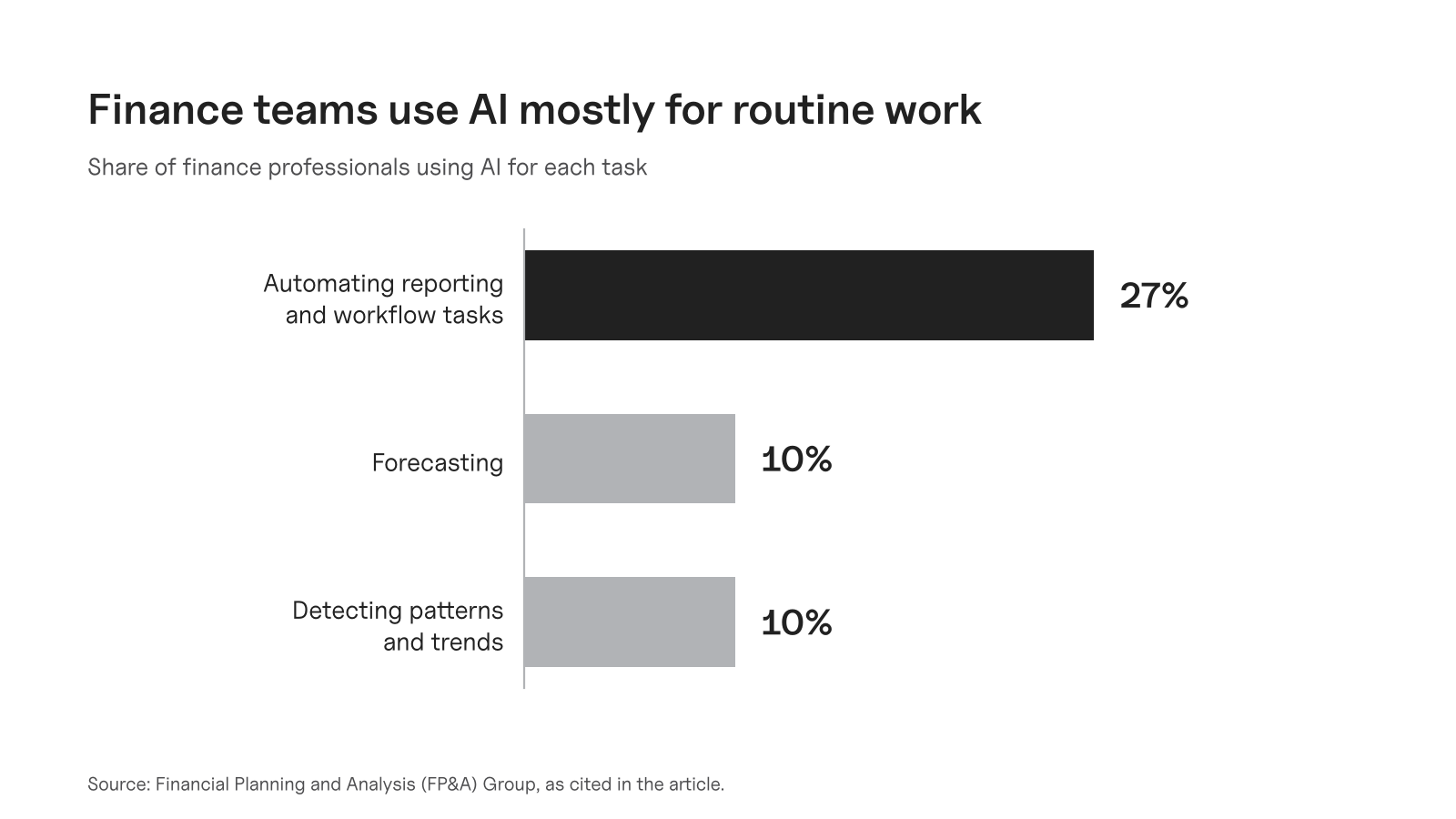
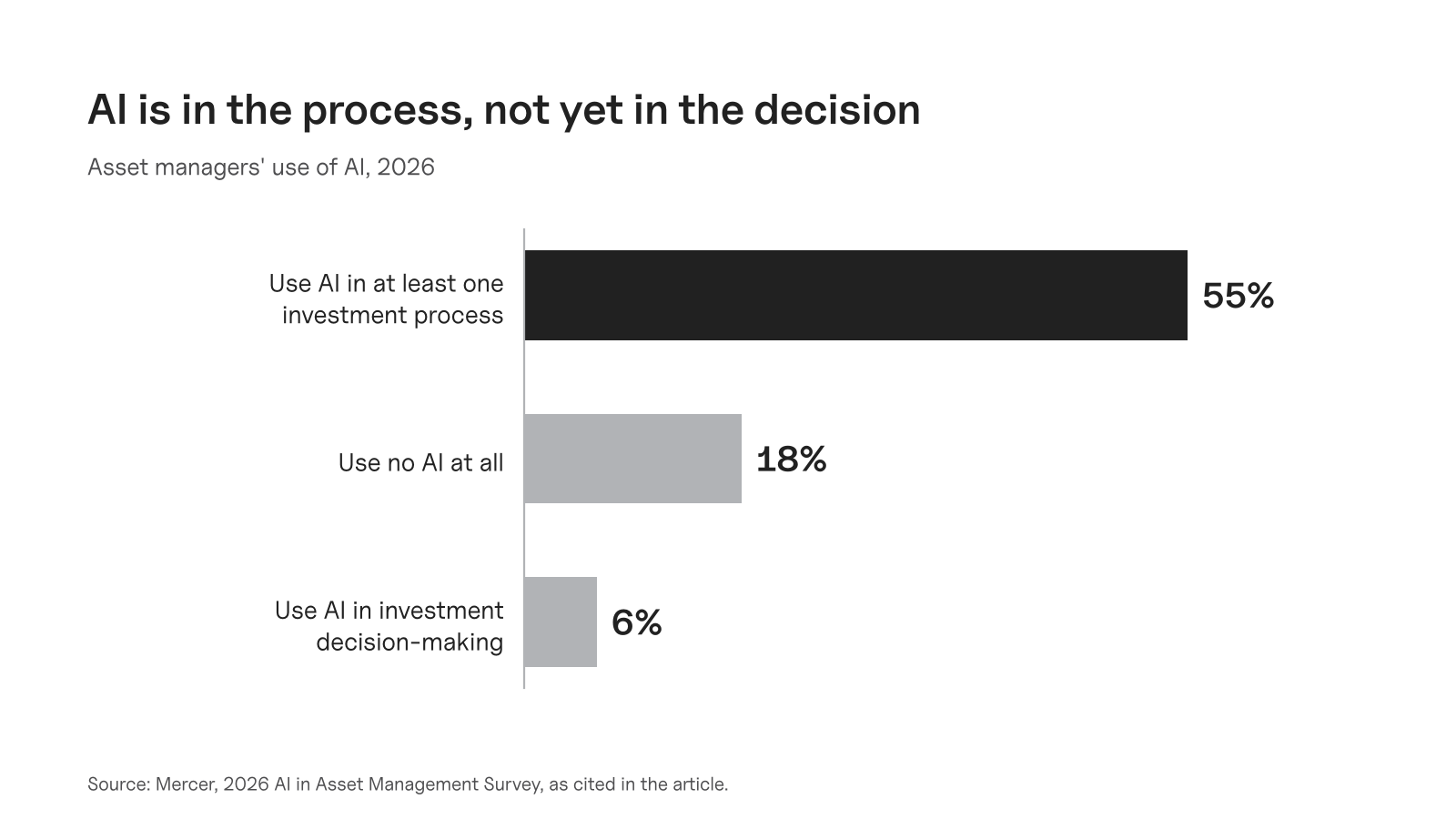
The group found professionals using AI for financial analysis across several verticals, with 10% applying AI to forecasting, 10% employing AI to detect patterns and trends, and 27% using AI to automate reporting and workflow tasks. Similarly, in its 2026 AI in Asset Management Survey, global research group Mercer reports that 55% of financial asset managers have integrated AI into at least one investment process, while 18% report no use of AI at all.
The rising trend has also caught the attention of the world’s biggest AI company. In May this year, Anthropic released a suite of finance-ready templates inside its “Claude” AI agent designed to help companies incorporate artificial intelligence in finance processes. Among them are templates for building pitchbooks, screening KYC files, and bookkeeping – operations tasks Anthropic says are among the most time-consuming in financial services.
Operations leads adoption while decisions stay human
As one might expect, Anthropic is right on the money with its AI finance tools, with both the FP&A Group and Mercer reporting that finance professionals are currently using AI mostly for operational tasks. The FP&A identified three distinct areas: the automation of manual or repetitive tasks (productivity enhancement), research mapping (insight generation), and financial modeling and forecasting (decision support and simulation).
The FP&A noted that AI models are enabling finance teams to analyze granular data to uncover links and potential risks that traditional models might have missed. This sentiment is echoed by Nestpoint’s chief financial officer Andrew Herzfeld, who says that AI is improving systems and processes significantly: “AI does an excellent job of searching for inputs or using logic to derive inputs where none can be easily found. [...] The speed and quality of the tools, when used properly, is phenomenal.”
Herzfeld adds: “I remember the first time testing this method. In one afternoon, I whipped up the most powerful financial model I've ever built to analyze a manufacturing opportunity, and manufacturing isn’t even the strongest area of my background.”
However, where AI is not yet finding a footing in finance - perhaps quite rightly - is final decision-making. According to Mercer, few asset management firms are embedding AI in either portfolio construction or trade execution, with just 6% saying they used AI in decision-making at all. The FP&A also noted a decline in the use of AI for financial forecasting, which fell to 6% among FP&A teams in 2024 compared to 11% in 2021.
Data distrust drives in-house solutions
Chief among the reasons given for this decline was a distrust of the data produced by third-party AI tools and fears over maintaining quality and auditability - both essential in finance environments. And this really sits at the heart of the current debate around the use of AI in finance.
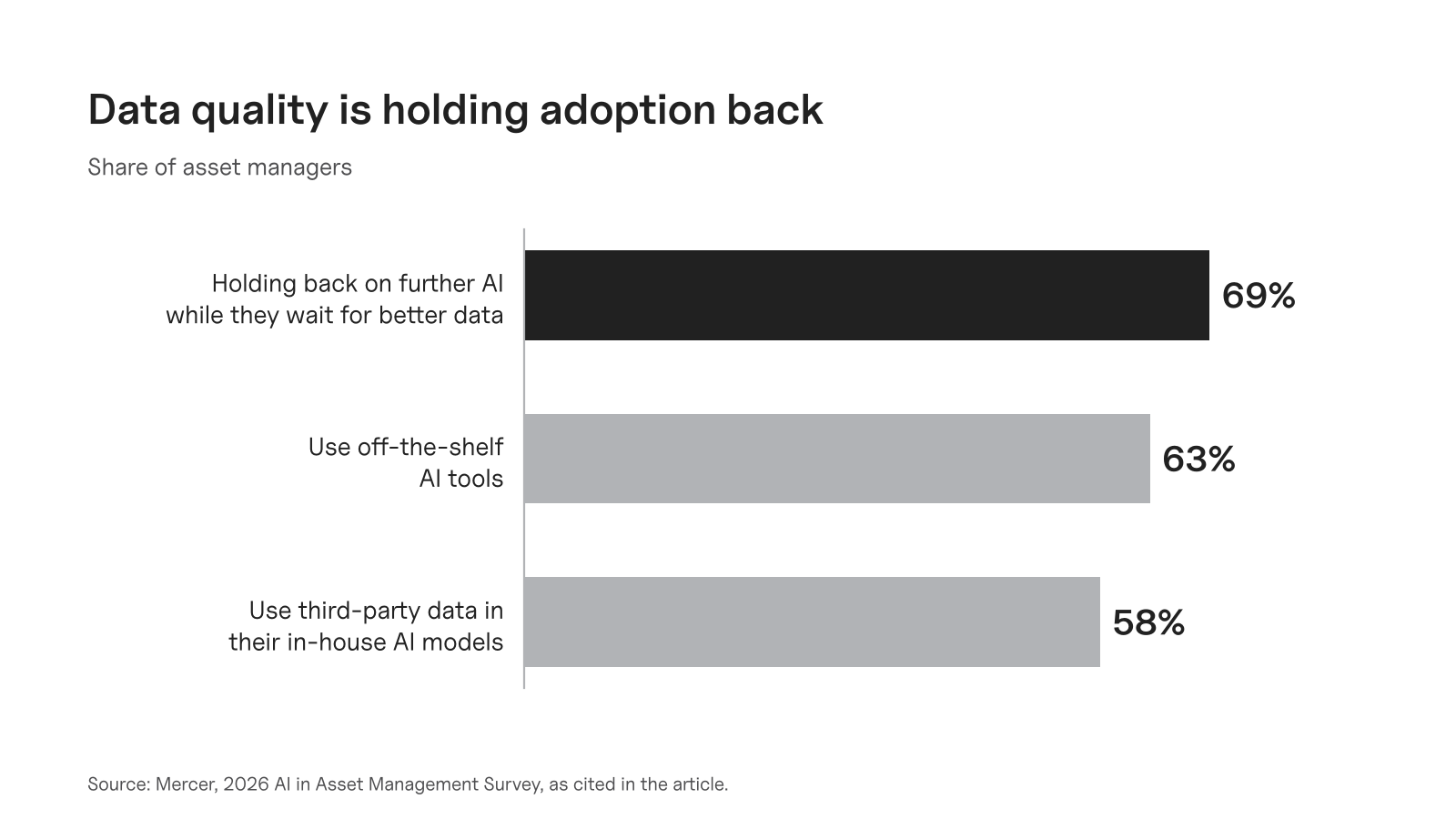
In its research, Mercer found that 63% of asset managers were using off-the-shelf AI tools when building their models, with 51% using vendor tools with some proprietary customisation. Of concern for Mercer, though, was the use of third-party data within in-house AI models, which it said was prevalent - at least to some extent - at 58% of firms.
The firm warned that dependence on third-party vendors for financial data can create “concentration risk” that could introduce “model, cyber, and continuity vulnerabilities.” As such, it said asset managers should fully understand where vendor data is coming from, if it is adequately licensed, and what due diligence is being done externally.
Beverley Sharp, Mercer’s global manager research leader, observes: “Investors should assess whether the manager uses rigorous methods, controls for common pitfalls (overfitting, look-ahead bias), and can demonstrate ongoing reliability. They should determine whether the operating model is durable with clear accountability, adequate staffing, third-party risk management, and suitable resilience controls.”
Ultimately, the gravity of this task means most asset managers are using in-house, proprietary models. These include Nestpoint, which has developed a fully customised AI finance model. As well as circumventing the pitfalls described above, Herzfeld says the team focuses on the quality of the human inputs, not least due to the well-documented limitations of AI agents when it comes to framing research, or defining the problem.
As an output-focused tool, the input is crucial, and so starting with human-led analysis and expertise is essential. This is what Herzfeld describes as the “garbage in, garbage out” principle: “For the most part, we build our tools in-house. We were fortunate to have been a highly data-driven enterprise even before AI matured to the level that it is now. And, as a result, our data was very clean and organized, which also happens to be the necessary foundation to extract value by using AI. It's the whole "garbage in, garbage out" thing.”
Nonetheless, Herzfeld acknowledges the difficulties of maintaining the quality of data when using AI, which he describes as a challenge for all financial firms looking to justify their investment in the technology. This is echoed by the respondents to Mercer’s study, with a huge 69% of firms saying they were holding back on implementing AI further as they wait for improvements in the quality and access of data from leading providers like Anthropic.
A way to go, but AI in finance is the future
It appears, then, that investment in internal systems is still crucial while third-party AI solutions are not yet up to scratch for the industry. Despite this, the use of AI in finance is already transforming the financial workforce. The FP&A says that, among surveyed teams currently using AI, 5% now spend more time on high-value tasks, 18% feel better optimized to perform their role, and 25% achieve higher forecast accuracy compared to non-AI teams.
Indeed, the group points to real transformation of traditional team infrastructure, stating, “AI is not just improving how financial planning and analysis operates, but also reshaping what the function is for.” Indeed, the firm goes so far as to say that “in an AI-enabled environment, the traditional analyst role is no longer sufficient.” This bright new future, it says, will be heralded by specialist data analysts and “architects” that can connect and integrate systems in ways that ensure the quality and compliance the industry needs.
Herzfeld echoes these sentiments, stating that he believes the integration of artificial intelligence in finance systems could eventually save managers, and ultimately their investors, significant money and time: “We know that we’ve only scratched the surface of the tool's potential. We've prevented the need for a lot of hiring - from entry-level positions to the highest level of expertise. One person can now be as effective, or even more effective, than a whole team that in the past we would have spent tens or even hundreds of thousands of dollars on, while losing months of back-and-forth in project management.”
The future for AI in finance is, then, bright, if not facing a seemingly long and bumpy road. While we have clear enthusiasm and growing usage, we also have finance teams pulling back over fears around the quality, reliability, and integrity of third-party tools, making them hesitant to integrate them into their models. However, once we see these concerns cleared up, adoption will almost certainly boom. And if anyone is working hard to solve problems today, it's the AI industry.
